“In today’s M&A landscape, SaaS waste isn’t just inefficiency—it’s a valuation killer. The right cloud due diligence can uncover millions in hidden liabilities and turn potential deal risks into strategic wins.”
Today’s M&A playbook has a new non-negotiable: an exhaustive audit of the cloud and SaaS estate before a term sheet is signed. Unused licenses, overlapping apps, and ballooning cloud commitments no longer look like rounding-error line items; they translate directly into discounted valuations, prolonged negotiations, and post-close integration nightmares. This deep-dive explores the scale of SaaS waste, why it erodes deal value, and how a data-first audit powered by SaaSrooms can surface hidden liabilities long before the closing dinner.
The Invisible Iceberg Beneath Every Deal
SaaS sprawl has reached historic levels. Enterprises now average 660 cloud apps, spending $4,830 per employee annually, yet 44% of those licenses sit idle. Average wasted spend per organization is $21 million—and rising year over year. In parallel, cloud-infrastructure commitments bleed cash: executives estimate 30% of compute outlay is wasted, equivalent to $44.5 billion in 2025 alone.
Waste Snapshots Across the Stack
Waste Category | Annual Global Waste | Typical Company-Level Impact |
Idle SaaS licenses | $21 million per org | 44% of licenses unused |
Unused software installs | 49.96% of desktop apps idle | $45 million lost per 6 million endpoints |
Cloud compute overspend | $44.5 billion in 2025 | 21% of infra budget wasted |
Engineering tool waste | $235,000 lost per 200 employees | 48% of EDA/CAD licenses idle |
Shadow IT SaaS | 1 in 6 employees expense apps | Audit exposure rises 30% |
Why Buyers Now Discount for SaaS Waste
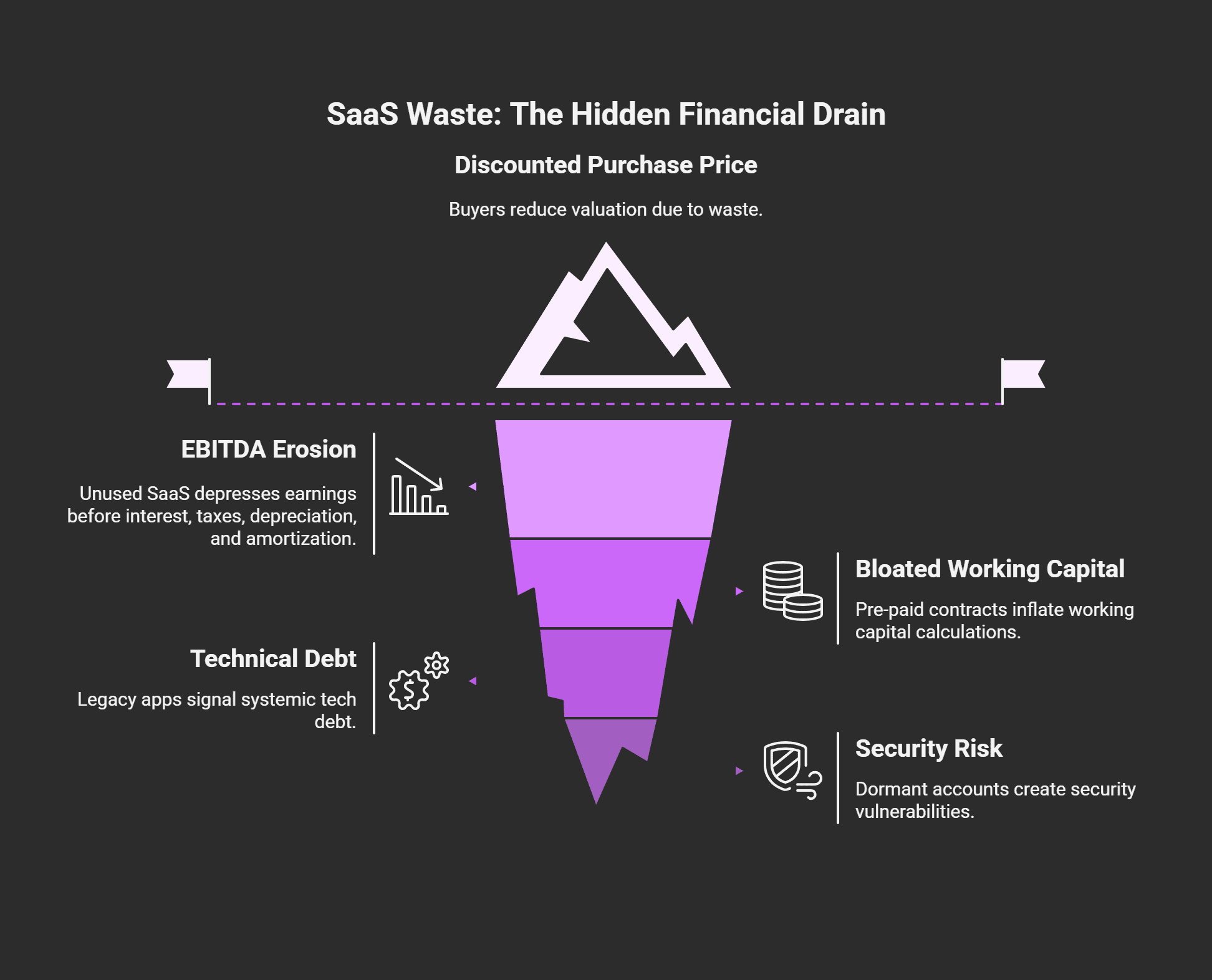
1. Direct EBITDA Erosion
Unused SaaS shows up as 100% OpEx with 0% ROI, depressing EBITDA and triggering purchase-price adjustments during quality-of-earnings reviews.
2. Bloated Net Working Capital
Pre-paid annual contracts inflate working-capital true-up calculations, transferring cash-flow pain to the buyer post-close.
3. Technical-Debt Multiplier
Legacy, overlapping, or non-integrated apps signal systemic tech debt that can shave 5–10% off enterprise value once remediation costs are capitalized.
4. Security and Compliance Risk
Dormant accounts create attack vectors; 16% of unused licenses still hold system access, driving audit-fee premiums for cloud-heavy clients.
Anatomy of a Modern Tech-Stack Audit
Traditional due-diligence checklists skim vendor lists and contract abstracts. That approach misses dynamic usage, true license posture, and cloud-cost commitments. Today’s leading PE funds and strategic acquirers layer seven data streams:
- AP and GL extracts – isolate SaaS, IaaS, and PaaS spend.
- SSO/IdP logs – map active vs. provisioned users.
- Browser telemetry – surface shadow IT access.
- Vendor API pulls – capture real-time usage metrics.
- Contract repositories – flag auto-renew cliffs and MFN clauses.
- Cloud billing exports – detail idle instances, orphaned storage.
- Security scanners – highlight dormant privileged accounts.
SaaSrooms: The Auditor’s Force Multiplier
SaaSrooms aggregates the seven feeds above in days, not weeks, using AI agents purpose-built for M&A diligence.
Agent | Due-Diligence Function | Sample Output |
SAVER | Quantifies waste & ROI scenarios | $6.2 million net savings wave 1 within 180 days |
NEGOTIATOR | Benchmarks vendor pricing vs. market | Identifies 7–20% rate variance across top-15 apps |
AUDITOR | Maps license vs. usage per user | Flags 1,840 dormant Microsoft 365 E5 seats |
CONTRACTOR | Builds renewal timeline & WC impact | Surfaces $1.9 million prepaid SaaS on BS date |
Rapid-Fire Assessment Workflow
- API + card feed ingestion – 24 h.
- ShadowSense extension deployed – 72 h to sample real usage.
- Savings heat-map & renewal waterfall – 5 business days.
- Valuation impact memo for deal team – day 6–7.
Quantifying the Valuation Drag
Consider a $150 million ARR SaaS target with 25% EBITDA. Due diligence via SaaSrooms uncovers:
- $12 million annual license waste (8% of OpEx)
- $4 million redundant cloud commitments
- $3 million technical-debt remediation tied to duplicative toolchains
Applying a conservative 10× EBITDA multiple, the buyer argues for:
- $12 million × 10 = $120 million price chip for OpEx waste
- Capitalized tech-debt fix = direct purchase-price reduction
Total haircut ≈ $150 million × (120/375) = $48 million, or 12.8% of equity value.
Integrating SaaS Waste Into LOI Language
Key Representations & Covenants
- “Seller represents no unused licenses > 5% of total seats across top-25 vendors at Closing.”
- “Seller shall remediate identified technical debt items > $250k within 90 days post-close; otherwise, purchase-price adjustment dollar-for-dollar.”
Case Study
A fast-growing tech startup preparing for a Series B round partnered with SaaSrooms to validate its cloud and SaaS spending before bringing bankers into the process.
Metric | Pre-Audit | Post-Audit (90 days) | Savings |
Annual SaaS spend | $2.9 million | $2.05 million | $850,000 |
Unused licenses | 38% | 9% | 29 pp |
Valuation impact (8× EBITDA) | +$6.8 million | — | — |
The cleanup directly lifted the company’s valuation ahead of its successful capital raise while freeing nearly $1 million in annual operating budget for continued product development.
Building the Pre-Acquisition Audit Playbook
10-Point Checklist
- Map every vendor > $5,000/year.
- Pull 12-month SSO logs for login frequency.
- Tag contracts with renewal notice periods.
- Benchmark unit pricing against market indices.
- Identify shelfware > 90-days unused.
- Classify all technical debt items & remediation cost.
- Quantify prepaid SaaS for working-capital true-up.
- Review SOC 2/SLA obligations for dormant apps.
- Model EBITDA uplift from license rationalization.
- Bake claw-backs into SPA for unbudgeted tech-debt overruns.
Beyond Risk Mitigation: Upside Value Creation
High-performing acquirers don’t just strip costs; they redeploy freed budget into roadmap acceleration. Companies that aggressively tackle technical debt grow revenue 20% faster than laggards. Eliminating waste funds the modernization that unlocks that growth.
Action Plan for Buyers, Sellers, and Advisors
For Buyers
- Mandate a SaaSrooms scan during confirmatory diligence.
- Link holdback escrow to tech-debt cleanup milestones.
For Sellers
- Run an internal SaaSrooms assessment six months pre-process to clean house and defend value.
For Advisors (IB, Legal, Accounting)
- Incorporate SaaSrooms dashboards into data-room QOE packs.
- Use AI-generated renewal waterfalls to tighten WC adjustments.
Conclusion: No Cloud Stone Unturned
Licenses that never launch and instances that never compute are no longer footnotes—they are valuation killers hiding in plain sight. Modern due diligence demands telemetry, AI analytics, and continuous optimization. SaaSrooms enables acquirers and sellers alike to expose waste, monetize fixes, and preserve deal value before signatures hit DocuSign.