Philip Allouche built SaaSrooms to solve software spend opacity in PE portfolios. He didn't expect AI governance to become the most urgent problem on the platform. Now it is — and he's built the infrastructure to address it.

Philip Allouche
CEO and founder of SaaSrooms Tech Spend Management. A recognised voice on SaaS cost intelligence, AI governance, and PE portfolio efficiency. SaaSrooms works with private equity firms and their portfolio companies across Europe and North America to surface, benchmark, and optimise technology spend.
There is a peculiar contradiction at the heart of most PE portfolios today. Boards are demanding AI strategies. Finance teams are approving AI budgets. And meanwhile, across the same portfolio companies, AI tools are already proliferating — informally, ungoverned, and largely invisible. Philip Allouche has spent the last eighteen months building the infrastructure to close that gap, and the story he tells is one the PE industry urgently needs to hear.
On the real state of AI in PE portfolios
When you look across the PE-backed businesses SaaSrooms works with today, what’s the actual picture on AI adoption? What are you seeing that most people in the industry aren’t?
The picture is simultaneously more advanced and more chaotic than most boards realise. AI tools are already running inside virtually every portfolio company we work with. ChatGPT, Copilot, various coding assistants, AI-powered CRMs, automated workflow tools — they’re there. The question is whether anyone knows they’re there, who’s using them, what data they’re touching, and whether any of it is delivering value.
The honest answer, in the vast majority of cases, is no. Leadership is flying blind. They know AI is happening because the board is asking about it and the finance team is fielding licence requests. But they don’t have a systematic view of the estate, they don’t know which tools are contracted versus shadow, and they absolutely cannot tell you whether the investment — formal or informal — is moving any needle that matters.
That’s the gap SaaSrooms is now built to close. And it’s more urgent than most people in PE appreciate, because the risks sitting in that gap are not theoretical. They’re regulatory, they’re reputational, and they’re financial.
"AI tools are already running inside virtually every portfolio company we work with. The question is whether anyone knows they're there — and whether any of it is actually delivering value."
Philip Allouche - CEO, SaaSrooms
On the security and governance layer
Let’s start with the risk side. When you talk about AI exposure inside portfolio companies, what are you actually finding — and what does the governance response look like?
What we typically find when we connect to a new portfolio company is a shadow AI estate that nobody has fully mapped. Employees using personal accounts on AI platforms, tools processing customer data with no data processing agreement in place, AI integrations built into workflows without any legal sign-off. This is normal. It’s not malice — it’s the speed at which AI has moved versus the speed at which procurement and legal functions typically operate.
The exposure is real, though. GDPR, Cyber Essentials, ISO 27001 — the obligations don’t pause because AI tooling moves fast. And when a GP is preparing a portfolio company for exit or a refinancing, the last thing you want a buyer’s diligence team to surface is a pattern of ungoverned data processing.
What SaaSrooms delivers is continuous visibility rather than a one-time audit. We map every AI tool in the estate — contracted or shadow — track every data flow, and surface every gap against the relevant compliance frameworks. We then produce a prioritised remediation roadmap, and our AI assistant can draft the security policies and board briefings needed to close those gaps. The result is a portfolio company that can demonstrate to any regulator or acquirer exactly what AI tools it runs, under what governance, with what controls. That’s a genuinely board-ready output, and it doesn’t require a consulting engagement to produce.
On data as the foundation of AI value
You talk about data quality as the foundation of any AI programme. Help me understand why that’s the starting point, not the finish line.
The single most important thing to understand about AI is that it can only be as good as the data it acts on. This sounds obvious, but the implications are radical — and most businesses haven’t internalised them yet.
If a portfolio company deploys an AI tool to improve sales forecasting, the quality of that forecast is entirely dependent on the cleanliness, completeness, and governance of the underlying CRM data. If a business uses AI to automate financial reporting, the output is only as reliable as the data flowing from its ERP systems. If a company runs AI across customer interactions, the insights it generates are shaped — and potentially distorted — by whatever data architecture it’s sitting on top of.
This is why SaaSrooms connects natively to the systems that generate and hold that data — NetSuite, Sage, Xero, QuickBooks, SAP, and the major cloud platforms. Not because we’re in the business of ERP integration for its own sake, but because the data those systems hold is what makes an AI programme credible. Governance and data quality are not the boring compliance work you do before the exciting AI part starts. They are the AI programme. Get them right, and the ROI is measurable and compounding. Get them wrong, and you’re generating confident, well-presented nonsense at scale.
"Governance and data quality are not the boring compliance work you do before the exciting AI part starts. They are the AI programme. Get them wrong, and you're generating confident, well-presented nonsense at scale."
Philip Allouche - CEO, SaaSrooms
On automatically building the AI business case
Every CFO and operating partner is being asked to justify AI investment right now. Building that business case is typically a months-long consulting project. You’re saying SaaSrooms can do it automatically. Walk me through how that works.
Building a credible AI business case is hard for one reason above all others: data. To model the ROI of AI investment, you need to know what the organisation is currently spending on the tools in scope, how those tools are actually being used, what productivity looks like today for the people who would be affected, and what comparable organisations with structured AI programmes have achieved. Most businesses don’t have any of those four data sets in one place. So consultants are hired to gather them, model assumptions, and produce projections that are ultimately educated guesses with a polished slide deck around them.
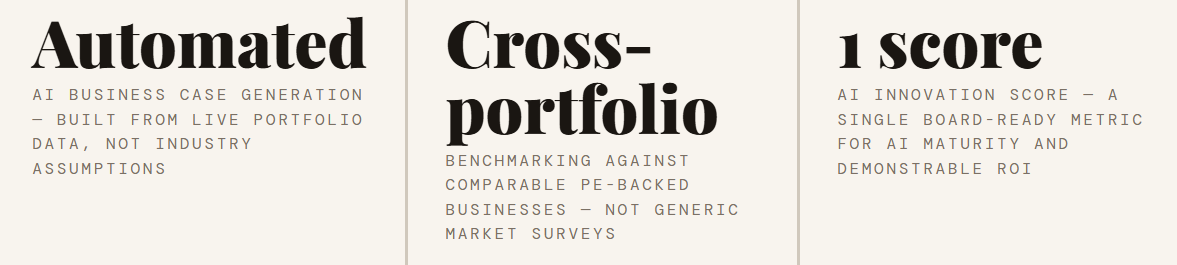
SaaSrooms sits on all four data sets simultaneously. We know the full technology estate and what it costs. We track adoption rates, session volumes, and utilisation patterns across every tool in the stack. We can benchmark AI users against non-AI users within the same organisation on measurable productivity indicators. And because we operate across a portfolio of businesses, we can benchmark a single portco against comparable companies at similar stages of AI adoption — not against generic market surveys, but against real businesses with real data.
The AI business case, which a consulting firm would take three months to produce at significant cost, is something SaaSrooms generates automatically from the data already in the platform. It includes a deployment roadmap, a staffing efficiency model, and what we call an AI Innovation Score — a single metric that gives leadership a clear, communicable view of where the organisation sits and what structured investment is realistically worth. For any portco approaching a board review, fundraise, or sale process, that’s not a nice-to-have. It’s an increasingly expected part of the story.
On immediate savings while the AI programme takes shape
AI governance and business case modelling are medium-term investments. What does SaaSrooms deliver in the meantime — and how does that sit alongside the broader programme?
This is something I’m genuinely proud of, because it solves a real tension. When a GP commits to an AI governance programme, they’re making a bet on future returns. That’s the right thing to do, but it creates pressure — particularly in the current fundraising environment where operating partners need to show EBITDA improvement now, not in eighteen months.
SaaSrooms addresses this by running automated savings programmes in parallel with the governance and AI work. Our optimisers for Microsoft 365, Azure, and AWS connect directly to a portfolio company’s cloud estate and begin generating savings recommendations immediately — continuously analysing licence utilisation, identifying idle or duplicated resources, and surfacing right-sizing opportunities without manual intervention. For most portcos, particularly those that have been growing fast and accreting technology spend without systematic review, these savings materialise within weeks of connection.
The practical effect is that SaaSrooms funds its own ROI while the AI programme takes shape. The cloud and SaaS savings run on autopilot; the governance and benchmark data builds in the background; and by the time leadership is ready to have the AI investment conversation, they already have a platform that is demonstrably saving money and a dataset that makes the business case credible. It’s a sequencing that works, and it’s one that operating partners find easy to take to their boards.
"SaaSrooms funds its own ROI while the AI programme takes shape. The cloud and SaaS savings run on autopilot — and by the time leadership is ready for the AI investment conversation, the business case is already built."
Philip Allouche - CEO, SaaSrooms
On the build vs. replace decision in an AI world
One of the most consequential technology decisions a portco faces right now is whether to maintain legacy systems or move to modern platforms. Has AI changed that calculus?
Profoundly. The build-vs-buy decision has always been about total cost of ownership versus capability — engineering time, maintenance overhead, security burden weighed against what a modern alternative delivers. AI has shifted both sides of that equation simultaneously, and in most cases has made it dramatically harder to justify the legacy position.
Modern SaaS platforms — Salesforce, HubSpot, BambooHR, the major ERP vendors — are now shipping embedded AI capabilities as standard. Features that once required years of custom development are available out of the box, continuously updated, and maintained by vendor engineering teams at a fraction of the cost. Meanwhile, the security overhead of maintaining a bespoke system has increased materially, precisely because AI models need clean, well-structured data to function. A legacy system that was “good enough” pre-AI is often a genuine liability in an AI-enabled organisation.
SaaSrooms includes a structured Build vs. Replace framework that models the true total cost of ownership of legacy systems — engineering time, maintenance, security overhead, opportunity cost — against what current market alternatives actually deliver, including their AI capabilities. For portcos carrying systems that haven’t been properly benchmarked in years, this analysis regularly surfaces reallocation opportunities that go straight to margin. And it’s particularly powerful for a GP who needs to make that case to a portfolio company management team that has emotional attachment to systems it built.
On what this means for private equity specifically
Private equity has a structural advantage that most businesses don’t: a portfolio. Multiple companies, comparable profiles, aggregated data. That advantage has historically been used for group purchasing and shared services. What SaaSrooms does is extend it into the AI era — using the cross-portfolio data to benchmark individual companies in ways they could never benchmark themselves, and to generate AI business cases with an evidential foundation that no standalone tool or external consultant can replicate.
The timing matters because the window for early-mover advantage is real but finite. AI adoption is accelerating. The GPs who build systematic, governed AI programmes across their portfolios now will be able to demonstrate measurable operational improvement at exit — in EBITDA terms, in efficiency metrics, in the AI Innovation Score that buyers are beginning to look for in due diligence. The firms that wait will get there eventually, but they’ll have left years of compounding value on the table and they’ll be telling a catching-up story rather than a leading one.
My ask to any GP or operating partner who reads this is straightforward: let us run the analysis on one portfolio company. We’ll show you the full AI and software estate, the security and governance gaps, the cloud savings available, and a draft AI business case — all built from real data, without a consulting engagement. When you see the numbers, the conversation changes completely. It always does.
"The GPs who build systematic, governed AI programmes now will demonstrate measurable improvement at exit. The firms that wait will be telling a catching-up story. That gap compounds."
Philip Allouche - CEO, SaaSrooms
is CEO of SaaSrooms Tech Spend Management. SaaSrooms helps PE-backed businesses and their investors surface, govern, benchmark, and optimise technology and AI spend — delivering immediate cloud savings, automated compliance intelligence, and the cross-portfolio data infrastructure needed to build a credible, board-ready AI programme.
SaaSrooms works with private equity firms and their portfolio companies across Europe and North America. Current capabilities include AI estate discovery and governance, automated cloud spend optimisation (MS365, Azure, AWS), cross-portfolio AI benchmarking, AI business case generation, and ERP integrations with NetSuite, Sage, Xero, QuickBooks, and SAP.